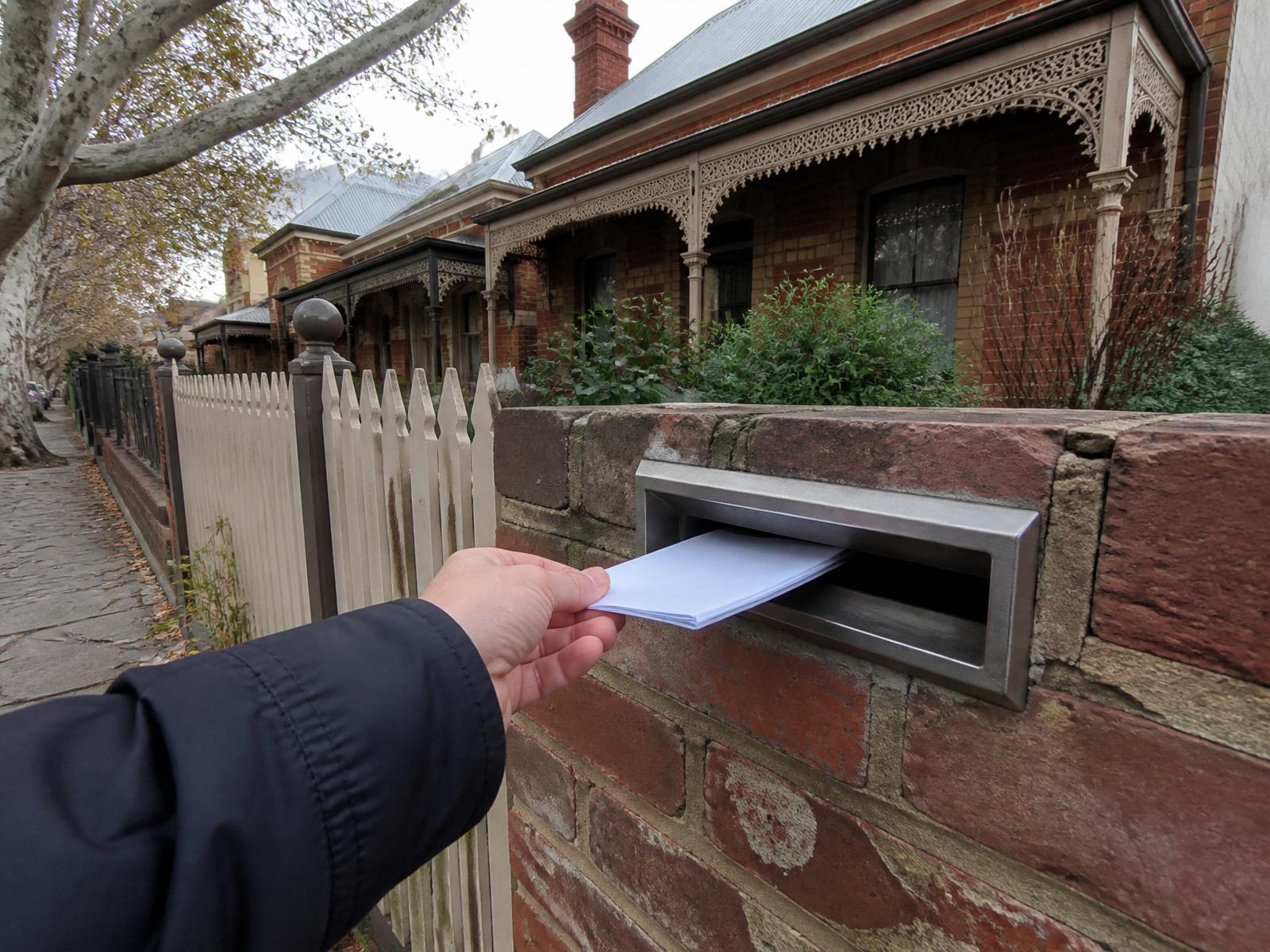
Can I Target Individual Postcodes With a Flyer Campaign?
Short answer, yes. Longer answer, the postcode is where you draw the line on a map, but the number that actually decides your quote and your result is the household count inside it.
You can target one postcode, five postcodes, or a single street within a postcode, and nothing stops you running a flyer campaign at that scale. The part that trips people up isn't whether it's possible. It's that a postcode is a mail sorting boundary drawn by Australia Post, not a marketing zone, and treating it like a clean, self contained unit leads to campaigns that either underquote the real number of doors or miss half the suburb they meant to cover.
This is a walkthrough of how postcode targeting actually works once you're past the idea stage and into booking a real run, using the same numbers and minimums that show up in our own quote builder.
What "targeting a postcode" means in practice
When you tell a distributor "just do 3121" or whatever postcode you've picked, what they actually do behind the scenes is convert that postcode into a set of walker rounds, streets grouped into a route a single person can cover on foot in a shift. The postcode is your instruction. The round is the unit that gets walked, tracked, and billed.
That distinction matters because postcodes and suburbs don't line up the way people assume. Some postcodes cover a single well defined suburb. Others span two or three, particularly around the inner city where postcode boundaries were drawn decades before the suburbs grew into their current shape. If your campaign genuinely needs one suburb and not its postcode neighbour, say the suburb name as well as the postcode when you book, and confirm the exact streets included before the run starts rather than after.
How many households are actually in your postcode
This is the number that decides your quote, and it's also the number most people guess badly. Population figures (the kind that show up first in a search) count people, not letterboxes, and a household of four counts once for delivery purposes and four times in a population figure. Here's a more reliable path to the real number.
- Start with your council's local suburb profile or the ABS QuickStats page for the postcode. Both list dwelling counts, and dwelling count is what you actually want, not population.
- Subtract for apartment blocks with a single shared letterbox bank if your product doesn't suit units, since a 40-unit building often counts as one drop rather than 40.
- Ask your distributor for the walk count instead of guessing from ABS data. A distributor who has actually run rounds in that postcode knows the real number of serviceable letterboxes, including the ones marked No Junk Mail that get skipped.
- Treat the ABS figure as your ceiling and the distributor's walk count as your real number. They're often 10 to 20% apart once opt outs and apartment buildings are accounted for.
In our own quote builder, you don't have to do this math yourself. Pick your suburb or postcode, set your quantity, and the tool prices it against real coverage data for that area rather than a census estimate, with the total updating live as you adjust quantity, paper stock, or whether it's a solus or shared walk. It takes under a minute to see the actual number for a specific postcode, which is faster and more accurate than working it out from ABS tables by hand.
Minimum order sizes and small postcodes
Our minimum order is 1,000 pieces, because below that the cost of routing a walker to a single small area stops making financial sense for anyone. Most Melbourne postcodes comfortably clear that on their own. A handful of small, tightly bounded inner suburb postcodes don't, and if that's the one you've picked, the practical fix is folding in an adjoining postcode or suburb rather than forcing a run that's too small to route efficiently.
This is worth checking before you commit to a single postcode as your entire campaign, particularly if you're a business with a genuinely tight service radius and the postcode you actually want is a small one.
Layering postcodes for a phased rollout
If you're testing a new offer, area, or flyer design, running every postcode you're interested in in one go is usually the wrong call. You end up with one combined result and no way to tell which postcode, or which part of the offer, actually did the work. Staggering it into waves costs you a bit of time but buys you a much clearer read on what's working.
- Pick one postcode as your test, ideally the one you already have some customer data from, and run it as a standalone (solus) drop so the result isn't muddied by other flyers in the same box.
- Wait for the response window to pass before judging it. A letterbox drop for a local service usually needs two to three weeks before you can read the response honestly.
- Add a second, adjacent postcode once the first has a result you trust, rather than launching three at once and losing the ability to tell which one worked.
- Keep the creative identical between waves unless you're deliberately testing a different offer. Changing the postcode and the message in the same wave means you can't tell which one moved the number.
- Book postcodes with genuinely different geography (say, one inner and one outer suburb) if you're trying to find where your offer travels best, rather than testing three postcodes that are basically the same suburb split three ways.
Campaigns over 10,000 pieces can already be scheduled in waves through us, which is the same mechanism you'd use for this kind of staged, postcode by postcode rollout. See how it works for how a wave gets booked in against a single timeline rather than as separate jobs.
Solus or shared, when you're testing by postcode
For a first run into an unfamiliar postcode, a standalone (solus) drop is the more honest test. Your flyer arrives on its own, without three other businesses' offers competing for the same thirty seconds of attention in the letterbox. Once you know a postcode responds, shared walks are the more economical way to keep a steady presence there without paying the solus rate on every repeat drop. Full detail on the difference is on the letterbox distribution page.
What it actually costs, postcode by postcode
Two postcodes with the same household count generally cost the same to distribute within, since the rate is driven by quantity and whether it's solus or shared, not by which specific postcode you've chosen. Where the cost genuinely shifts is density. A tightly packed inner suburb postcode lets a walker cover more letterboxes per hour than a sprawling outer one with long driveways and set backs, and that efficiency shows up in the per drop rate at the margins. Current rates by volume are on the pricing page, and you can configure your exact postcode and quantity in the quote builder to see the number that actually applies to you.
Frequently asked questions
Can I choose an exact postcode for my flyer distribution?+
Yes. You pick the postcode (or postcodes) and we quote against the actual number of serviceable letterboxes in that area, not a population estimate. Every metro Melbourne postcode is covered.
How many households are in a typical Melbourne postcode?+
It varies enormously, from a few thousand in a small inner suburb postcode to over 15,000 in a sprawling outer growth corridor. There's no single answer, which is why we quote against the real walk count for your specific postcode rather than a rule of thumb.
What's the smallest area I can target?+
Below full postcode level, you can usually specify particular suburbs or streets within it if your minimum order (1,000 pieces) is met. If a postcode itself doesn't reach 1,000 households, we'll suggest folding in a neighbouring postcode.
Can I run the same flyer in five postcodes at once?+
You can, but we'd usually suggest staggering it into waves instead, especially for a first campaign. Running everything at once means if the offer underperforms, you won't know whether it was the offer, the postcode, or the timing.
Do postcodes match suburb boundaries?+
Not reliably. Postcodes were built for Australia Post's mail sorting, not for marketing, so a single postcode can span more than one suburb and a single suburb can be split across two postcodes. Confirm the actual boundary with your distributor before you assume a postcode equals a suburb.
See the real number for your postcode
Configure your postcode, quantity and paper stock and get a live price in under a minute.