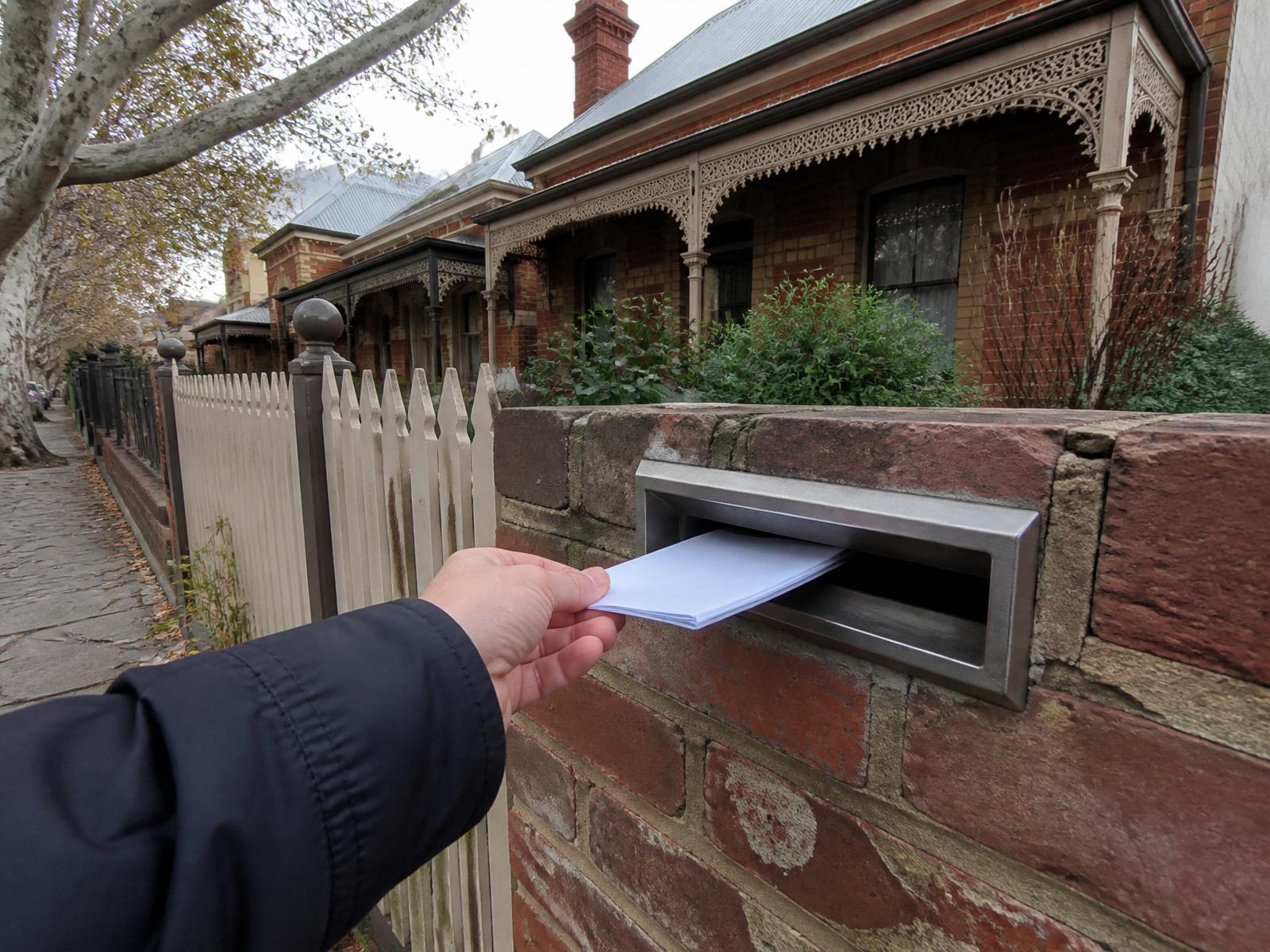
Flyer printing for the Melbourne CBD
Printed flyers built for a city campaign, and distribution into CBD offices or onto CBD streets, under one booking. The print specs are the easy part. Getting past a reception desk in a 90-minute window is the part that decides whether the campaign works.
CBD flyer campaigns fail for reasons that have nothing to do with the design or the offer. They fail because the print run was ready but the distribution slot had already passed, or because a flyer built for a suburban letterbox got binned at reception before it reached a single desk. This page covers what makes the CBD different from printing for anywhere else. For sizes, stocks, artwork specs and pricing, see flyer printing.
What "flyer printing CBD" usually means
Two different searches hide behind the phrase. Some people want a printer physically close to the city, for easy drop-off or pickup. Others want flyers printed for a CBD campaign, ending up in the hands of office workers, commuters, or lunchtime crowds.
If you're the second kind, printing and distribution aren't really separate decisions. The stock, the size, even the wording all depend on where the flyer lands: a reception desk, a train station, a lunch spot. Treating printing as a standalone task and sorting distribution out later is how CBD campaigns lose momentum halfway through.
Why the CBD is a different job from the suburbs
There are no letterboxes
Office buildings don't have them. A flyer aimed at a CBD business has exactly one entry point: a person, usually reception staff, who decide whether it goes any further.
That changes what successful delivery even means. A residential drop succeeds the moment the flyer is in the box. A CBD drop only succeeds if reception passes it along, or the person receiving it decides it's worth keeping rather than binning on the spot.
The reception filter is real
Reception desks see a constant stream of flyers, menus and promotional material, and most of it is binned before lunch. What survives tends to share three traits: it feels substantial rather than flimsy, it doesn't announce itself as junk mail on sight, and it's handed over with a specific reason rather than a generic pitch.
The first of those is a printing decision, and it's why CBD campaigns generally start at 250gsm rather than the 120gsm that's perfectly adequate for a letterbox. The reasoning is covered in full under paper stocks.
The timing windows are narrow
Suburban letterbox runs can happen more or less any time during the day. CBD distribution can't. Offices are empty before about 8:30am and start clearing from 5pm. Reception staff are busiest, and least receptive, during the first hour of the day and around 1pm when the building's own lunch rush is happening.
That leaves narrower windows than most people expect. Mid-morning or mid-afternoon before the 5pm exodus for office and reception drops. Roughly 12 to 2 for street-level hand-to-hand outside the building rather than inside it, when there's genuine foot traffic to work with. A CBD campaign has to be planned around these windows rather than against them, and there aren't many of them in a week.
Why the print date isn't your real deadline
Printing alone takes 3-5 business days, or 5-7 from booking with distribution bundled, and same-day printing is available before 1:30pm. Those numbers matter less here than they do elsewhere.
The scarce resource in a CBD campaign is the distribution window, not the press. There are only so many mid-morning slots in a week, and a print run finishing one day late doesn't cost you a day, it costs you the slot. That's the specific reason to book printing and distribution as one job rather than two: when both sit with one provider, a slipped print date gets solved against your actual distribution date instead of becoming a scheduling problem nobody owns.
What a CBD campaign costs
Location doesn't change print pricing. A flyer printed for Collins Street costs the same as one printed for Craigieburn, and the variables are the ordinary ones: quantity first, then stock, size, and sides. Full detail is on the flyer printing page and current rates are on the pricing page.
Where CBD campaigns do cost more is per-piece distribution and stock. Business drops price higher per stop than letterbox delivery, because each one is a person walking into a building and having a conversation rather than a walker working a street. And reception-gated distribution rewards heavier stock, which costs more to print. Both are real costs, and both buy you the only thing that matters in this channel: getting past the desk. Configure a campaign in the quote builder for exact numbers.
Which CBD precincts matter
The Melbourne CBD isn't one uniform block, and treating it as one wastes budget. The precincts worth knowing before you print:
- Collins Street financial precinct: Dense with office towers, best suited to business drops and reception-based distribution.
- Southbank: A mix of corporate offices and residential-office towers. Worth checking which type of building you're targeting before committing to one method, because the same street can need two different approaches.
- Docklands: Newer office stock, generally easier building access, still reception-gated.
- QV and Bourke Street retail core: Heavier foot traffic, better suited to hand-to-hand than office drops.
Knowing which of these matches your audience before you print saves you from producing the wrong flyer for the wrong precinct, which is not a mistake you can fix after the run.
How the flyers actually get there
Two methods work in the city, and they suit different goals. Business drops target office buildings directly, with a distributor visiting reception at addresses on your target list. That suits B2B offers and anything aimed at office workers specifically. Hand-to-hand works the street instead, handing flyers to commuters, café queues and lunchtime foot traffic. That suits consumer offers, events, and anything that benefits from volume and visibility.
Most CBD campaigns use one or the other rather than both, depending on whether your audience is "people who work in these specific buildings" or "anyone walking through this part of the city at lunchtime."
Before you book
- Decide whether your audience is inside buildings (business drops) or on the street (hand-to-hand), because it changes your stock, your size, and your timing.
- Book the distribution window first, then work the print date backwards from it. The slot is the scarce thing, not the press.
- Build a buffer between print completion and the distribution slot rather than booking them back to back.
- Confirm which CBD precincts your distributor actually covers, since not every provider works every part of the city.
- Book printing and distribution through the same provider so nobody has to reconcile two timelines under pressure.
Frequently asked questions
How fast can I get flyers printed for a CBD campaign?+
Printing alone takes 3-5 business days, or 5-7 business days from booking if distribution is bundled. For anything tighter, same-day printing is available on orders confirmed before 1:30pm. But for a CBD campaign the print date usually isn't the constraint, the distribution slot is. Office and reception drops only work mid-morning or mid-afternoon, so confirm both together before you commit.
How much does flyer printing cost in Melbourne CBD?+
The same as flyer printing anywhere else. Location doesn't change print pricing. What moves the price is quantity, paper stock, size, and single versus double sided. CBD campaigns tend to cost more per piece than suburban ones because reception-gated distribution rewards heavier stock, not because the CBD carries a premium.
Can you print and distribute flyers in the CBD?+
Yes, as a single booking rather than a printer and a distributor coordinated separately. For CBD campaigns that matters more than elsewhere, because the distribution windows are narrow enough that a print run finishing a day late can cost you the slot entirely.
What's the best time of day for CBD flyer distribution?+
Mid-morning or mid-afternoon for office and reception drops, avoiding the first hour of the day and the 1pm lunch rush when reception staff are busiest and least receptive. Roughly 12 to 2 for street-level hand-to-hand, when there's genuine foot traffic rather than an empty forecourt.
Ready to print and deliver?
Get an instant price for printing and CBD distribution, bundled into one campaign.